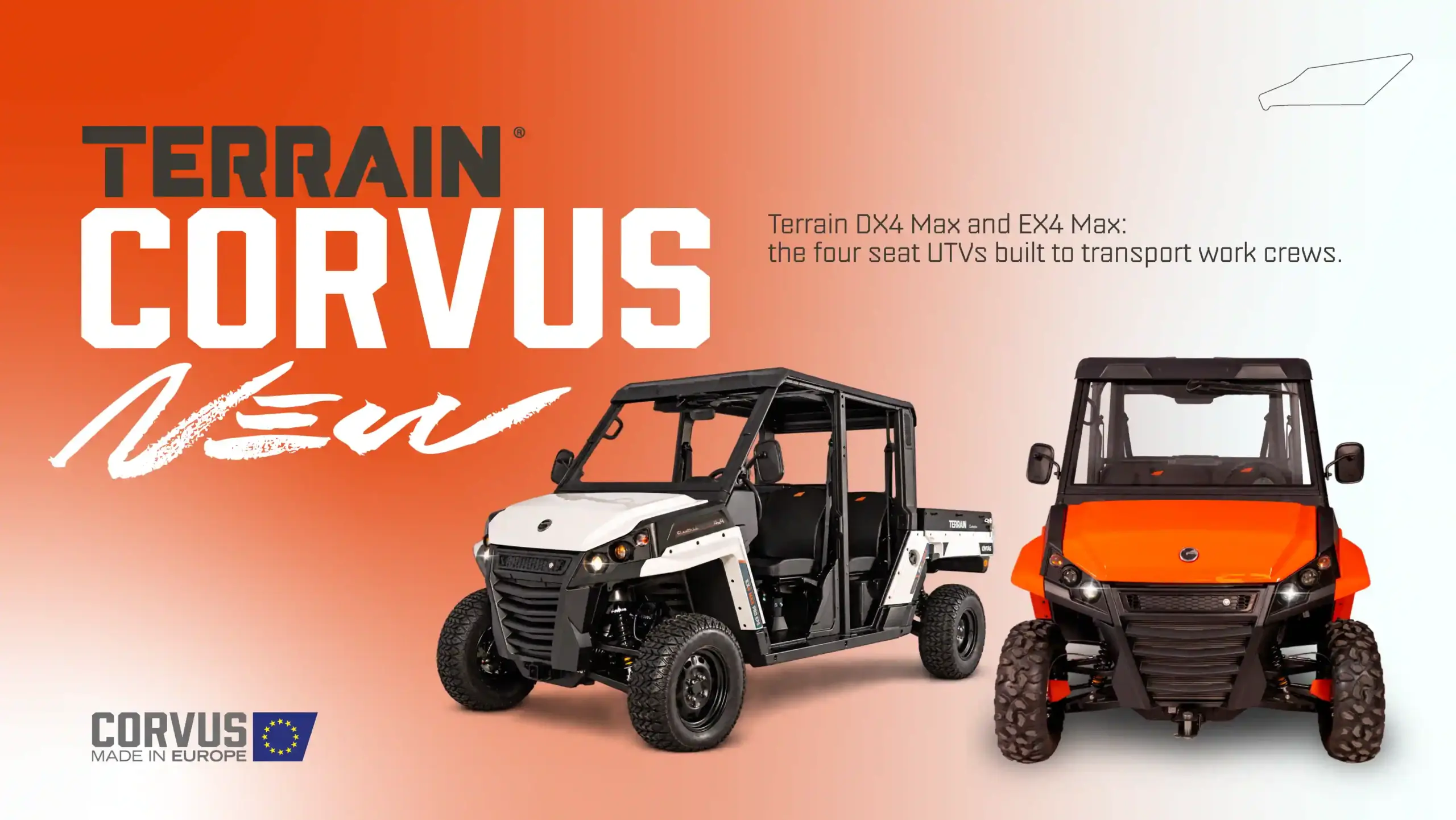
Corvus expands the range Terrain with two four-seater UTVs: the Terrain DX4 Max, with a Yanmar diesel engine, and the Terrain EX4 Max100% electric. Both feature a second row of seats and are homologated for four seats with three-point seatbelts on the same 4x4 platform as the rest of the range.
The seats weren't just added to a cargo vehicle. The vehicle was designed around them: to transport a full team to the work site, with their tools and PPE, along roads where a van can't go, and to repeat this shift after shift.
Two questions remain, and this article addresses them: what changes with respect to Terrain which you already knew and which of the two engines suits you best.
What changes compared to the rest of the range Terrain
The second row, and little else. That's the short answer.
The MAX versions add an adjustable bench seat in the rear without altering the platform. The wheelbase remains at 3.048 mm, ground clearance at 285 mm, and the independent double wishbone suspension retains its 287 mm of travel. The turning radius is 5,68 m, and the tilting steel cargo bed is still present with its dimensions of 1.185 × 1.305 × 300 mm.
Four seats on a platform that remains 4x4
Maintaining these dimensions is crucial. Ground clearance, suspension travel, and weight distribution underpin a work UTV's off-road capabilities, and these are the first things to suffer when a vehicle grows in size. The cabin was designed with this fundamental principle in mind: that the vehicle should handle the same whether it's empty or carrying four occupants. All four seats are certified, each with a three-point seatbelt, within a maximum authorized weight limit of 1.400 kg.
Carrying four people is one thing. Being responsible for them all day, on rough terrain and with a fully loaded vehicle, is another. The useful question when looking at a vehicle's specifications isn't how many seats it has: it's what the vehicle is still capable of doing with all four passengers.
Two engines for the same job
In this segment, the gasoline engine is the norm. Corvus It offers diesel and electric versions, and the reason lies in the type of use they are intended for: torque available at low speeds and autonomy for long days, in one case; absence of emissions and low noise level, in the other.
Terrain DX4 Max
Yanmar three-cylinder, 1.000 cc liquid-cooled diesel engine with 24 hp (18 kW) and 52,1 Nm of torque at 2.400 rpm. LHNR automatic transmission and 40-liter fuel tank.
- EU approval T1a at 40 km/h and T1b at 60 km/h
- Tare weight of 950 kg on a maximum authorized mass of 1.400 kg
- Payload of 450 kg and towing capacity of 900 kg
- Warranty of up to 3 years
Full data sheet of Terrain DX4 Max
Terrain EX4 Max
Air-cooled 48V AC induction motor with 13 kW nominal and 25 kW peak power. 15 kWh LFP battery with 3 kW AC charger, LH gears and two driving modes: Range and Power.
- Range of up to 80 km depending on usage
- EU T1a approval at 40 km/h
- Tare weight of 1.100 kg on a maximum authorized mass of 1.400 kg
- Payload of 400 kg, and towing capacity of 450 kg without brakes or 900 kg with brakes
- Warranty of up to 5 years
Full data sheet of Terrain EX4 Max
DX4 Max o EX4 MaxHow to choose
| Terrain DX4 Max | Terrain EX4 Max | |
| Motorization | Yanmar diesel 3 cyl. 1.000 cc | AC 48V Induction |
| Power | 24 hp (18 kW) | 13 kW nominal / 25 kW peak |
| Onboard power | 40 L tank | 15 kWh LFP battery |
| Autonomy | See "Important Notes" at the bottom of the page | Up to 80 km depending on usage |
| Professional | T1a 40 km/h and T1b 60 km/h | T1a 40 km/h |
| Tara | 950 kg | 1.100 kg |
| Useful load | 450 kg | 400 kg |
| pull | 900 kg | 450 kg without brakes / 900 kg with brakes |
| Warranty | Up to 3 years | Up to 5 years |
Common to both models: 4.121 × 1.650 × 1.993 mm · wheelbase 3.048 mm · ground clearance 285 mm · turning radius 5,68 m · GVWR 1.400 kg · 4 seats with 3-point seatbelt · 4×2 / 4×4 with rear differential lock · EPS · hydraulic discs · full underbody protection.
UTVs are homologated as agricultural vehicles, and this homologation does not include fuel consumption testing, so we don't publish a diesel range figure that we couldn't verify. The data is the fuel tank capacity: 40 liters.
Three criteria, in this order.
The environment dictates everything else. If the work is indoors, in a residential environment, or in a noise-sensitive space, the EX4 Max It's the only one of the two options that qualifies. There, zero emissions and noise levels cease to be an environmental argument and become an access requirement.
Then, the workday and the plug. If the vehicle is parked in the same spot every night and the daily commute fits comfortably within 80 km, go for the electric car. If it's parked in shifts, changes charging stations, or doesn't have a reliable outlet where it's parked, then go for the diesel and its 40 liters. That's the logic of the comparison of real cost per kilometer.
Finally, the movement between centers. If it is necessary to connect facilities via public roads at speeds exceeding 40 km/h, only the DX4 Max homologates T1b at 60 km/h.
The rule: The environment decides first. If there are no noise or emissions restrictions, the daily range and the location where the vehicle is parked decide.
And if no more than two people ever travel together, the second row is weight you won't use: that's where two-seater versions come in, which we review in the comparison by activity.
Where does a 4-seater UTV make sense?
Golf courses and sports facilities. The team sets out early with their equipment to a point along the course and returns. The electric car adds silence, which is no small detail on a playing field. Full throttle in the golf course maintenance guide.
Vineyards and estates. The crew that moves between plots during the harvest and the staff who tend to the estate the rest of the year. The vineyard lanes are UTV territory, not van territory.
Resorts, hotels and large properties. Maintenance and technical services circulating through areas with guests. In the resort management guide.
Municipal brigades and environmental services. Beaches, parks and areas where a large vehicle cannot or should not enter.
Construction and contractors. Access to the work area with equipped personnel and materials in the same vehicle. More details in the guide for contractors.
Forestry, emergencies and industry. Crews, intervention teams, and internal deployments in large plants. Emergency use, in the rescue vehicle guide.
Finishes and equipment
The two MAX versions are offered in three finishes: BASE, PRO y CAB, the latter with option CAB HEATER.
The BASE trim already includes the ADVANCE roof, adjustable bench seat, three-point seatbelts, and EPS power steering as standard. The PRO trim adds a windshield enclosure, under-seat storage compartments, and an interior rearview mirror. The complete list is available in each model's specifications.
FAQ
How many places does it certify? Corvus Terrain MAX? Four, in both versions, each with a three-point seat belt.
What is the difference between the Terrain DX4 Max and the Terrain EX4 Max? Motorization, and with it two practical things: the DX4 Max It refuels in a couple of minutes and is homologated T1b at 60 km/h; the EX4 Max It emits no emissions or noise, and stays in T1a at 40 km/h. In terms of capacity they are equal, with 450 kg of payload versus 400 kg, and 900 kg of towing capacity for both, unless the electric trailer does not have brakes, in which case it drops to 450 kg.
How much autonomy does the EX4 Max And how long does it take to load? Up to 80 km depending on usage, with a 15 kWh LFP battery and a 3 kW AC charger. This figure is for the MAX version, a four-seater with a curb weight of 1.100 kg; the two-seater versions have different ranges. Charging is done overnight using a standard household outlet.
Is it legal to drive a 4-seater UTV on public roads? It depends on the vehicle's homologation and the regulations of each country. DX4 Max EU homologates T1a at 40 km/h and T1b at 60 km/h, and the EX4 MaxT1a at 40 km/h. [PENDING — real data to avoid making things up: registration, license and insurance in Spain.]
Tell us about your work
A useful conversation with someone considering one of these vehicles rarely starts with the model. It begins with two pieces of information you already know: how many people travel daily and where the vehicle is parked each night. With that information, the choice between the DX4 Max and the EX4 Max It resolves itself.
Any of our official distributors will make that comparison with you before you decide anything.